India Power Sector Value Chain
 PRIYANKA
India’s power story is shifting from pure generation to the entire value chain, where transmission, equipment, and distribution play a critical role in delivering and monetising power. With demand expected to grow at ~6.3% CAGR and a ₹9.15 lakh crore transmission push, the opportunity is structural, not cyclical. The real beneficiaries extend beyond generators to wires & cables, power equipment, and smart metering, making this a broad-based capex cycle across the grid ecosystem.
India Power Sector Value Chain
India’s power story is no longer just a generation story.
The real story now is the entire value chain.
Because adding more electricity is one thing.
Delivering it reliably, moving it across states, balancing renewable volatility, reducing losses, and actually collecting cash is a completely different challenge.
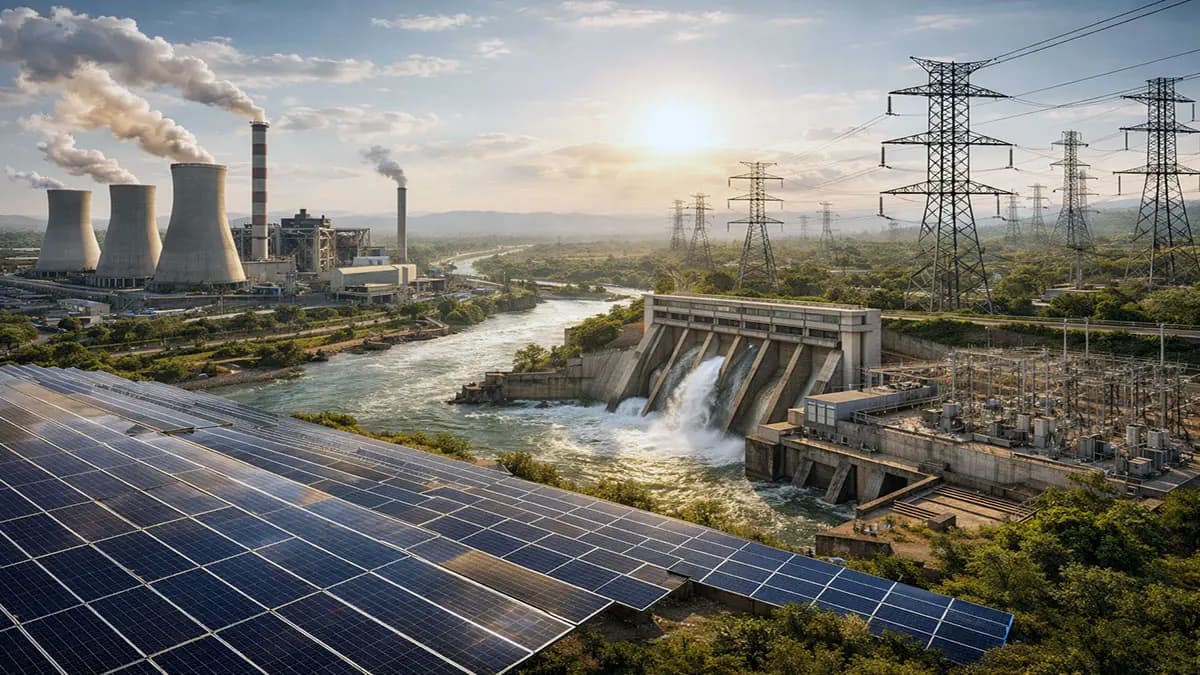
And that is exactly why the Indian power sector is entering a much broader capex cycle than most investors think. India’s total installed generation capacity stood at 520.5 GW as of 31 January 2026, and the government says 272 GW of that was from non-fossil sources, including 263 GW of renewable energy and 8.78 GW of nuclear.
Now look at the demand side.
The IEA expects India’s electricity demand to grow at 6.3% CAGR from 2025 to 2027, faster than the country’s own 2015 to 2024 average of 5%. That means this is not a short-term spike. This is a structural demand expansion supported by economic growth, electrification, and rising cooling demand.
This is where the real framework begins.
👉 To understand the sector properly, the power value chain should be divided into six layers:
- Generation
- Transmission asset ownership
- Transmission EPC
- Wires, Cables & Conductors
- Power equipment manufacturing
- Distribution and smart metering
- Grid automation, storage, and balancing
And honestly, I think this is the right way to study the sector now.
👉 Generation is still important, of course.
Names like NTPC, Tata Power, JSW Energy, Adani Power, Adani Green, NHPC, and SJVN all sit here in different ways.
But generation is not one single business model.
Thermal, hydro, renewables, merchant power, and regulated utilities all behave differently.
That is also why just looking at installed capacity can be misleading.
A solar plant and a thermal plant may both have 1 GW capacity on paper, but they do not produce the same number of units through the year. So, the real story is the capacity added. It is also utilisation, reliability, fuel economics, PPAs, and cash flow quality.
Where things get really interesting, in my view, is transmission.
Because no matter what the future looks like, transmission wins.
🔹 If India adds more solar, transmission is needed.
🔹 If more wind comes up, transmission is needed.
🔹 If EV charging scales, transmission is needed.
🔹 If data centres grow, transmission is needed.
🔹 If green hydrogen becomes meaningful, transmission is needed.
That is why this part of the value chain feels the strongest structurally.
And the capex visibility is massive.
👉 India’s transmission plan for 2023 to 2032 targets expansion of the network to 6.48 lakh circuit km, transformation capacity to roughly 2,345 GVA, inter-regional transfer capacity from 120 GW to 168 GW, with planned investment of about ₹9.15 lakh crore.
That is a serious number.
And it tells you where the long runway is.
The listed names that stand out here are Power Grid, IndiGrid, and Adani Energy Solutions.
Personally, this is the cleanest part of the power story for long-term compounding.
Once these assets are built and operational, the business becomes much more stable than project-based or commodity-linked segments.
👉 Then comes the next layer: Transmission EPC.
This is where companies like KEC International, Kalpataru Projects, Techno Electric and L&T come in.
These businesses benefit early in the cycle because they see order inflows first.
But the market should not judge them like asset owners.
This is a lower-margin, execution-heavy business.
Order book matters. Execution matters. Working capital matters.
A big project pipeline looks good, but if cash is stuck or projects get delayed, returns can disappoint.
Then there is the equipment side, and this is where I think many investors may still be underestimating the opportunity.
This part includes transformers, switchgear, GIS, substations, cables, conductors, HVDC equipment, and grid systems.
Names here include Hitachi Energy India, GE Vernova T&D India, CG Power, Siemens Energy India, APAR Industries, Polycab, and KEI.
This segment is attractive because it sits somewhere between manufacturing scale and technology value-add.
It is not as stable as a transmission owner, but in many cases, it can be a better business than EPC, especially when the mix shifts towards high-voltage systems, digital substations, automation, and grid-control solutions.
👉 The power buildout is also a wires and cables story:
Once new power capacity is added and new lines are planned, the system needs the actual products through which electricity moves. That is where wires, cables, and conductors come in.
In simple terms, if transmission is the highway, then wires, cables, and conductors are the actual lanes on that highway.
And this is not a small industry.
Polycab’s latest presentation puts the Indian wires and cables market at around ₹900 billion in FY25, which is roughly 40% to 45% of the electrical industry. The company also says the market grew by around 12% YoY in FY25. Its own estimates suggest Polycab held around 26% to 27% share of the organised market and 19% to 20% of the total market.
The size of the segment is also visible at the company level. A competitive assessment on Polycab’s site shows FY25 wires-and-cables revenue at about ₹188.9 billion for Polycab, ₹88.6 billion for KEI, ₹71.8 billion for Havells, ₹66.9 billion for RR Kabel, ₹50.1 billion for Finolex Cables, and ₹46.4 billion for APAR Industries.
The demand drivers are strong. Transmission expansion supports conductor demand, while distribution reforms drive the need for ABC, underground cables, and upgrades. This is not just a new capex cycle but also a replacement cycle, with older networks being upgraded. Key names to track include APAR Industries, Polycab, KEI Industries, RR Kabel, Finolex Cables, and Universal Cables.
A lot of investors think renewable growth mainly helps renewable developers.
But that is only half true.
👉 Renewables are built where the resource is strongest.
Demand is somewhere else.
So once renewable capacity rises, the grid needs much more than just generation.
It needs evacuation, balancing, voltage support, and long-distance transfer.
That is why renewable growth indirectly strengthens the case for Power Grid, Adani Energy Solutions, KEC, Hitachi Energy India, GE Vernova T&D India, and others linked to transmission and grid systems.
Then comes distribution, which is where the quality of the sector really gets tested.
Because generation and transmission may look strong, but distribution decides whether the system actually collects money.
👉 This is why smart metering matters so much.
Government data shows AT&C losses improved from 21.91% in FY21 to 15.04% in FY25. Smart meters installed across schemes reached about 5.62 crore by January 2026, and sanctioned works under RDSS were around ₹2.83 lakh crore.
So smart meters are not just an electrical equipment story.
They are a billing, collection, and cash-flow story.
The clearest listed proxy here is Genus Power.
And then there is the final layer, which will likely become more important over time: automation, storage, and balancing.
The future grid will not run only on generation plus wires.
It will run on:
generation + transmission + storage + digital balancing
As the renewable share rises, the grid will need more flexibility.
That means better control systems, better balancing tools, and more advanced transmission architecture.
That is where names like Hitachi Energy India and GE Vernova T&D India become even more interesting, because this is not just about selling equipment. It is about helping the grid handle a more complicated future.
📌 So, if I had to simplify the entire sector into one line, I would say this:
Generation creates electricity.
Transmission makes scale possible.
Wires and cables carry that power across the network.
Distribution makes monetisation possible.
Automation and storage make the future grid workable.
_1783769780040.png&w=3840&q=75)
_1783766890311.png&w=3840&q=75)
_1782728608439.png&w=3840&q=75)





_1768996873080.png&w=3840&q=75)




_1755606872650.png&w=3840&q=75)