US - Iran Conflict and the Global Economy: Why the Strait of Hormuz Matters More Than the Battlefield
 PRIYANKA
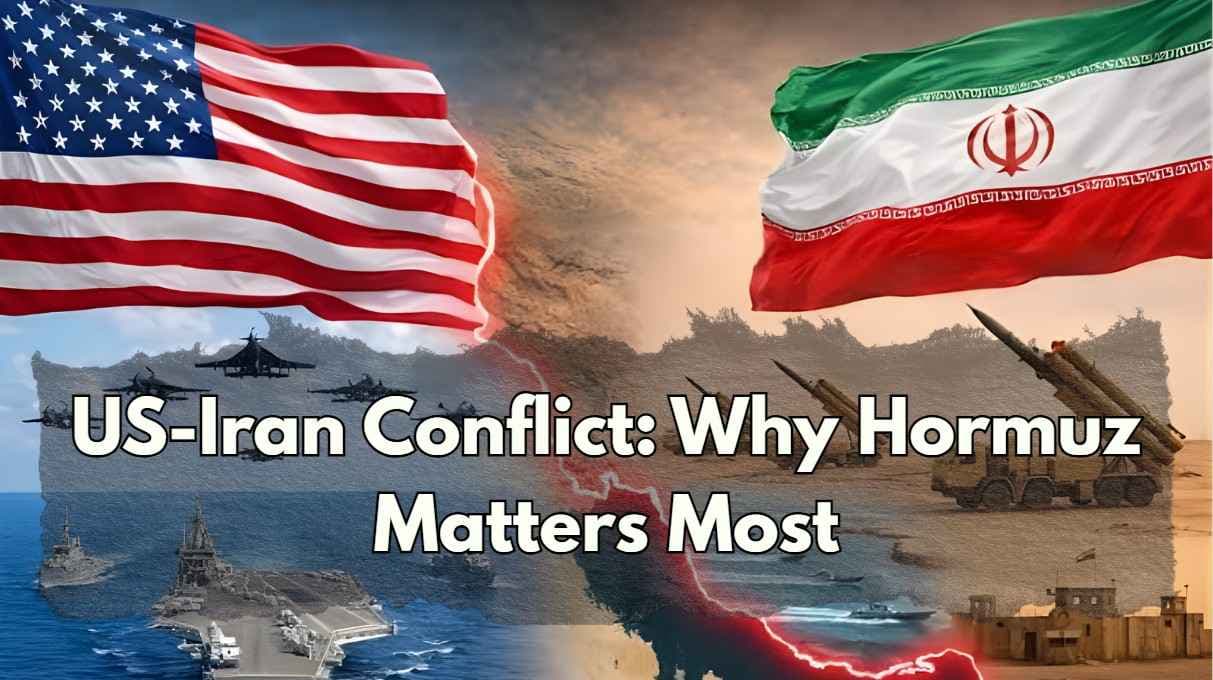
The US–Iran conflict has entered its third week, and markets now see it as a global energy shock due to disruptions near the Strait of Hormuz, a key route for global oil and LNG trade. Brent crude has crossed $100 per barrel, raising concerns about inflation and slower growth worldwide. The economic impact depends on how long the conflict lasts. A short disruption may cause temporary volatility, but a prolonged conflict could push energy prices higher and significantly affect global growth, inflation, and economies like India that rely heavily on oil imports.
The conflict has already entered its third week, and markets are increasingly treating it as a serious energy shock rather than a localized geopolitical event. The main reason is the disruption around the Strait of Hormuz, a critical global energy chokepoint through which a large share of the world’s oil and LNG trade passes.
Reuters reported that Brent crude settled at $103.14 per barrel on March 13. Barclays, in its base case, assumes normalization within two to three weeks, but warns that if disruption extends to four to six weeks, Brent could reprice to around $100 on a sustained basis. Goldman Sachs has also lifted its near-term Brent forecast to above $100 for March, although it still expects prices to ease later in the year if the disruption does not become prolonged.
From an economic perspective, the duration of the conflict matters far more than the headlines. The longer the disruption lasts, the more likely it is to evolve from a temporary price spike into a broader inflation, trade, and growth shock.
Three Practical Duration Scenarios
1. Short war or short disruption: a few weeks
This is the least damaging outcome.
Chatham House notes that if the conflict does not last long and there is no lasting damage to energy production or transport infrastructure, the spike in oil above $100 could prove temporary. In that case, inflation in Europe and Asia in 2026 may rise by only about 0.5 percentage points above pre-conflict forecasts, with limited damage to economic growth.
This view broadly aligns with Barclays’ assumption that conditions around Hormuz could normalize within two to three weeks. Under this scenario, the world experiences a temporary inflation scare, market volatility rises for a short period, but the broader economic system absorbs the shock without major structural damage.
2. Medium-length war: one to three months
This is the more realistic risk case for the global economy.
Chatham House suggests that if the conflict persists for several months, oil could move toward roughly $130 per barrel before easing later. Such a scenario would weaken growth unevenly across regions, with energy-importing economies taking the brunt of the damage.
This would create a classic stagflation-lite environment: slower growth, stickier inflation, and weaker consumer confidence. Central banks would become more cautious because growth would be slowing just as inflation starts rising again. In such an environment, expected rate cuts could be delayed, and financial conditions could remain tighter for longer.
3. Prolonged war or entrenched Hormuz shutdown: several months or more
This is the true tail risk.
According to the IEA, around 20 million barrels per day of oil and petroleum products moved through the Strait of Hormuz in 2025, accounting for about 25% of global seaborne oil trade. Roughly 19% of global LNG trade also depends on this route. While some of these flows can be diverted through alternative pipelines, only a portion can be rerouted effectively.
This means a sustained disruption would not remain just an “Iran story.” It would become a global energy, shipping, and supply chain shock. In such a scenario, oil could remain well above $100 for long enough to affect industrial costs, transport economics, inflation expectations, and financial markets across the world.
What Does This Mean for the Global Economy?
The main transmission channel is energy.
The Strait of Hormuz handles roughly one-fifth of global petroleum liquids consumption and about one-fifth of global LNG trade, according to the EIA. Even a partial disruption therefore matters disproportionately. Asia is especially vulnerable. EIA estimates suggest that in 2024, around 84% of crude and condensate and 83% of LNG moving through Hormuz were destined for Asian markets.
That creates five major global consequences.
1. Higher inflation
Oil, gas, shipping, aviation fuel, chemicals, fertilizers, and plastics all become more expensive. The shock does not remain confined to energy markets. It gradually moves through the cost structure of the broader economy.
2. Slower growth
As households spend more on fuel and energy, less income remains available for discretionary consumption. Businesses also face higher transport and input costs, which compresses margins and slows investment appetite.
3. Financial market volatility
Equity markets generally struggle in such environments, especially sectors with weak pricing power or high fuel exposure. Safe-haven assets and energy-linked assets tend to outperform, while risk appetite weakens.
4. More cautious central banks
If inflation rises again because of energy, central banks may have less room to cut rates. Chatham House has explicitly warned that, in a severe case, the Fed could abandon expected rate cuts and the ECB could become more hawkish.
5. Sharp sector divergence
Energy producers, defense companies, and some shipping firms may benefit. On the other hand, airlines, chemicals, paints, logistics-heavy businesses, and fuel-intensive manufacturers could come under pressure.
What Does It Mean for India?
India is more vulnerable than many large economies because it imports the bulk of its crude oil requirement and remains heavily exposed to Gulf energy routes.
Reuters reported that if oil averages $100 per barrel for much of FY27, India’s current account deficit could widen to 1.9% to 2.2% of GDP, compared with earlier projections of 0.7% to 0.8%. It also cited SBI Research estimates suggesting that if oil remains near $100, India’s GDP growth could slip to 6.6%, while inflation could rise to 4.1%. If oil averages $130, growth could fall further to 6.0%.
India’s vulnerability is amplified by geography. The IEA notes that nearly 90% of LNG exported via Hormuz in 2025 was destined for Asia, and EIA data show that Asian markets dominate oil flows through the strait as well. That means a Middle East energy shock tends to hit India faster and more directly than it hits many Western economies.
India’s exposure is especially visible in LPG and crude logistics. Government briefings indicate that roughly 70% of India’s crude imports are now routed outside Hormuz, which provides a meaningful buffer. However, India still imports around 60% of its LPG consumption, and about 90% of those LPG imports reportedly come through the affected Hormuz route. That is why LPG availability, gas allocation, and industrial fuel shortages have emerged as immediate pressure points.
India’s Key Pressure Points
1. Rupee pressure
A larger oil import bill means higher demand for dollars, which puts pressure on the rupee. A weaker rupee then makes imports even more expensive, creating a second-round effect. Reuters notes that this concern has already pushed the rupee to a record low and forced RBI intervention through dollar sales.
2. Inflation pressure
Fuel affects transport, food distribution, fertilizers, aviation, and manufactured goods. Reuters reported that analysts estimate roughly 40 basis points of annualized CPI impact for every $10 per barrel rise in crude under full pass-through, although the actual effect is often softened by government policy and the actions of oil marketing companies.
3. Fiscal pressure
If higher crude costs are not fully passed on to consumers, the burden shifts to subsidies or state-owned oil companies. Reuters cited Elara Securities as estimating that government expenditure could rise by ₹3.6 trillion in the next financial year if oil averages $100, with fertilizer subsidies alone potentially rising by ₹200 billion.
4. Equity market rotation
In India, upstream oil and gas companies, some defense names, and select commodity-linked businesses may hold up relatively better in such an environment. In contrast, paints, tyres, aviation, oil marketing companies under pricing pressure, chemicals, and consumption-oriented businesses may face margin compression if crude remains elevated. This is an inference from sector cost structures rather than a direct forecast.
Could India Manage the Shock Better Than Feared?
Yes, but only under certain conditions.
India is not entering this phase from a position of complete vulnerability. Government sources indicate that crude sourcing has now been diversified across more than 40 countries, with a larger share coming from non-Hormuz routes. Domestic LPG production has reportedly been increased by 25% under emergency measures. India has also secured selective transit relief for some flagged vessels through diplomatic engagement. These are meaningful buffers.
_1783769780040.png&w=3840&q=75)
_1783766890311.png&w=3840&q=75)
_1782728608439.png&w=3840&q=75)




_1768996873080.png&w=3840&q=75)




_1755606872650.png&w=3840&q=75)